Scotland Area Outreach Event 2026
For many years, I became involved in the BMFA University Challenge weight lifting competition, along with Alistair Duff who worked in the Engineering lab. Strathclyde University Engineering Faculty used the competition as the focus of their third year design course. We did our test flying near Edinburgh at a model club site that had a bit of hard runway, and the BMFA competition used the limitless concrete of Elvington, Yorkshire Air Museum. I was the pilot of the Strathclyde team.
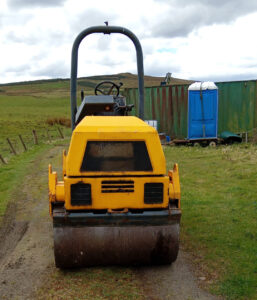
the runway was rolled, the loo serviced
As the course gained in popularity and student numbers grew, the logistics of transporting the teams to York increased. And when the BMFA moved the event to Buckminster, the problems became impossible. Rather than invent a new design course, they decided on an in-house version, still using Alistair and myself, and the CVF club’s grass runway. The club prepared the grass runway, including rolling with a vibrating machine, and laid on drinks in the club hut. We even had the loo serviced.
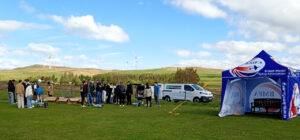
Models were unloaded from the vans
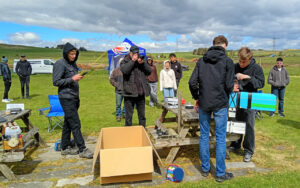
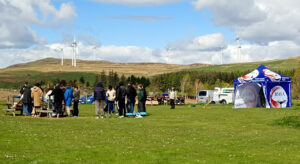 Aircraft were assembled
This year, with the assistance of the BMFA Scotland Area, the club had improved facilities and set aside three days for the University’s use, one for test flying, one for competition and one spare. We had 72 students, in teams of six, designing and building twelve aeroplanes capable of carrying golf balls, for a change (last year it was tennis balls).
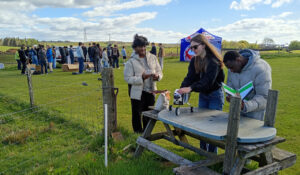
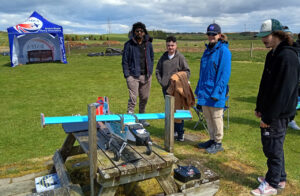
Test day was hectic, and I totally lost count, but I think I test flew a dozen aeroplanes. A few crashed (but none burned), a few needed some improvements (stronger undercarriages mostly) and some few just fine.
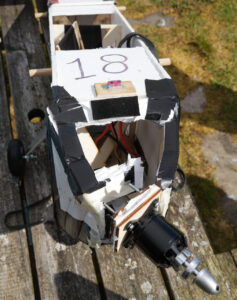
Not all made it!
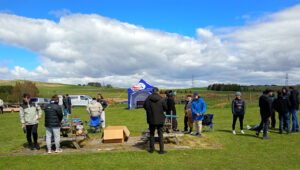
Not all twelve models made it to the competition day, but those with minor undercarriage or control surface problems had been repaired to take part. The format was that the team members present had to assemble their model, and we checked it over. Then each team was given ten minutes to carry as many balls as possible around the sky. They had to place it on the runway, arm the motor, and stand by to watch as I flew a left hand circuit, with a right hand circle on the downwind leg, and then land on the runway. The students then retrieved their model, unloaded it into the arrivals bucket, and reloaded for another circuit, until their ten minutes expired, or their battery was flat, or their model was too badly damaged to fly again.
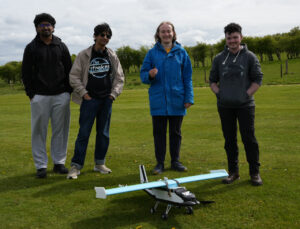
This team placed second
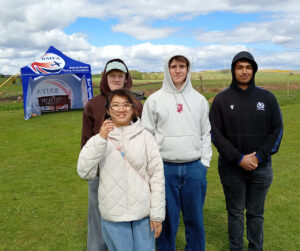
And here are the proud winners.
Not all 72 students turned up on the day (just as well) but 2, 3 or 4 from each design team was enough to keep the competition running, and exciting, and kept me busy. At the end of the day we had a winning team, whose aircraft made several circuits and carried a lot of balls. Please see attached photographs. Next year we hope to have a model simulator available to give the students a chance to find out how challenging model flying can be.